As you pick up the freshly made hot cappuccino, a quick swipe or touch and $3.49 gets securely transferred. We may not realize the effortless activity when paying for a coffee or a grocery bill, or any money transaction in return for goods or services, but there is a lot that happens behind the scene to securely debit one ledger and credit another. The digital money transfer transaction looks like a child’s play, but it carries a significant cost, and often a lot of time and complexity. User-friendly secure digital transfer of money has undergone a major shift in the last 2-3 decades, starting back in the early ’90s when Pizza Hut (PizzaNet) experimented with the idea to order a Pizza on the world wide web to today when global digital payments run in several trillion dollars and countries like Sweden are turning completely cashless. Look around and most of our money transactions rely on digital cash in-app wallets, bank accounts, or credit card all of which are controlled by centralized clearing systems. But all of this could change with blockchain, a technology powerhouse that offers a decentralized system and heralds a new era in the history of money. Blockchain offers wide-ranging applications across several industries including real estate, Health care, Insurance, etc. and we will explore scenarios where it could solve, disrupt as well as create new businesses in the world of media and entertainment.
Digital Currency, Double Spending, and Blockchain
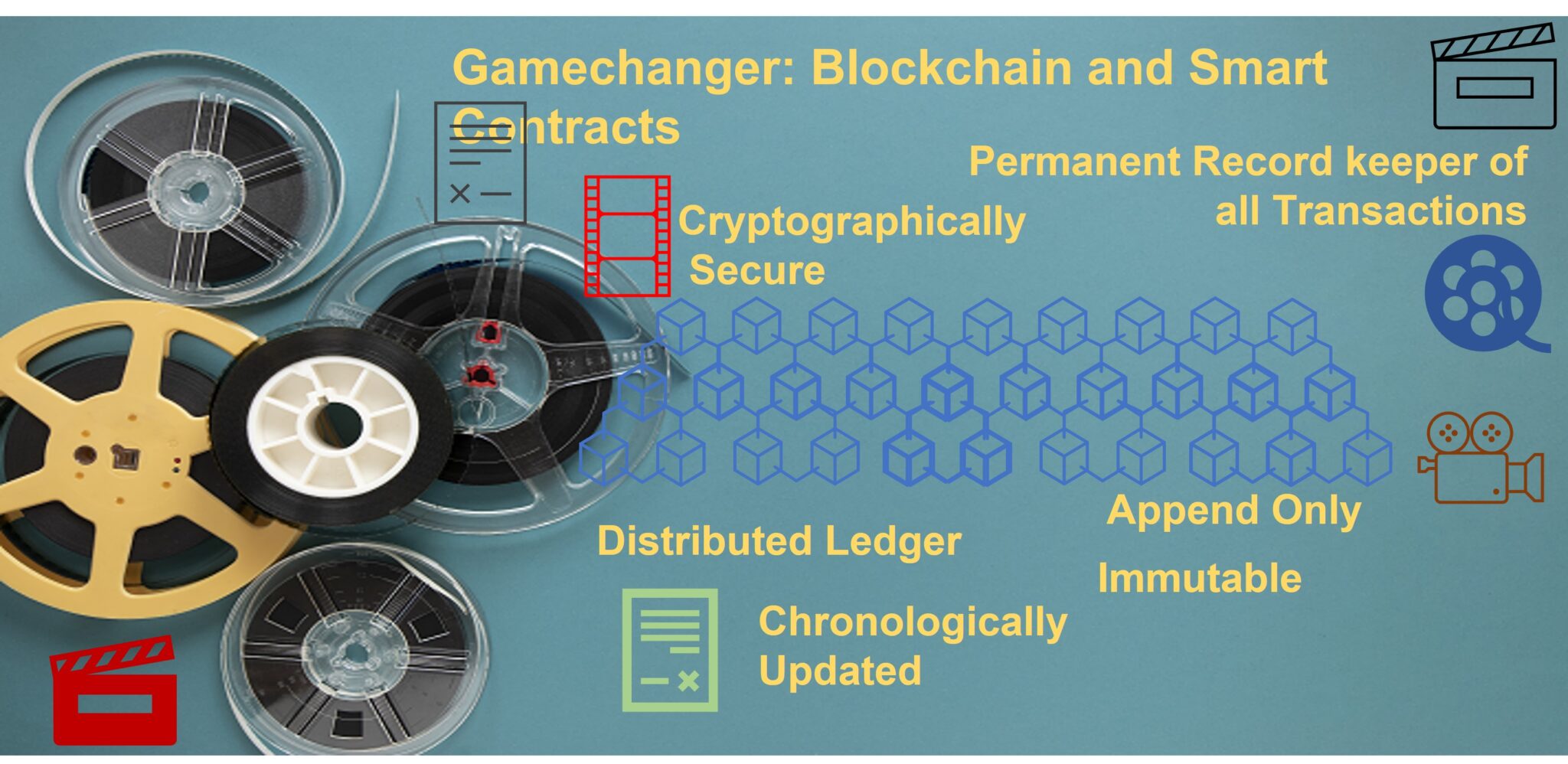
Digital currency inherits properties similar to traditional currencies without the physical form, but being digital enables them to be transacted near instantaneously making them convenient and popular. But unlike physical cash where once a transaction is complete, and physical paper changes hand, digital money in form of a token or transaction can be copied and spent more than once – causing a complex issue of double-spending. In order to manage double spending, we need a gatekeeper that centralizes the transactions among trusted parties (like banks) and verifies by cross-checking each transaction to avoid misuse. Hence the system has its roots in centralization or popularly called CeFi (Centralized Finance) which adds exorbitant fees to absorb the inherent risk and to provide clearing and settlement services. CeFi works great except centralization adds cost and significant delays leading to the need for decentralization. Here, the financial industry witnessed several pioneering but unsuccessful attempts since the early ’90s (like Digicash, Cybercash, Hashcash, etc.) to solve and build a non-centralized, secure digital payment system, but it was the Halloween of 2008 when a paper by Satoshi Nakamoto finally nailed it. Nakamoto proposed a new digital cryptocurrency called Bitcoin, with an approach to solving the issue of double-spending. The proposed system is based on a peer-to-peer electronic cash system with no trusted third party, and a new decentralized blockchain, which is resistant to modifications once a block of the transaction has been recorded. Hence Blockchain offers a replacement to banks’ centralized cleaning system with a distributed immutable ledger that chronologically records transactions based on the consensus of network participants. Simplifying further – a system that adds transactions to a distributed ledger, is time logged, append-only, is updated upon consensus, secure, immutable, and is a verifiable database. Here Blockchain’s consensus-driven shared ledger becomes the foundation for transaction record keeping, verification, traceability, and ownership which opens tremendous opportunities across multiple industries.
Impact of Digitalization on Media Industry
While digitalization truly changed media consumption with anywhere, anytime, any device flexibility and created several new businesses, it also added a significant pitfall, digitalization enabled with ease the ability to copy and distribute content, which continues to threaten large sections of the media value chain. Napster did it with music and Youtube changed it for the TV industry. While the innovation with content sharing also created new businesses (like OTT streaming services, content aggregators, etc.), it largely commoditized content, accelerated piracy and significantly undermined intellectual property (IP). As a result, we currently have an entire generation of users accustomed to free content with reluctance to pay for the “premium” content. Technologies like content protection, rights management and user authentication, etc. have tried to help, but disregard for IP and copyright infringement remains rampant, often leading to payment disputes, and inhibits the true realization of the long-chain value of the content. Enter blockchain and Smart Contracts, and tables are turning in favor of copyright owners by enabling trust, traceability, and secure transactions, especially in the domain of micro-payments, revenue distribution, and royalty realization.
Blockchain and Smart Contracts – Gamechanger for Media Industry
Blockchain promises ways to effectively track Intellectual property across channels and value chains. Content ownership can be accurately established, and usage can be properly tracked, digital rights can be enforced and microtransactions can be credited to rightful owners. Our existing money transfer systems with centralized risk and mediation offer limited avenues for minimum practical transaction size and the possibility for small casual transactions. Blockchain technology with smart contracts can effectively bypass platform providers, content aggregators, as well as royalty collection associations to a large extent. Let’s explore some key opportunity domains plagued by challenges and how Blockchain offers great potential to disrupt and provide pathbreaking alternative
| Opportunity Domain | Current Challenges | How Blockchain Solves / Disrupts Status Quo | Examples of Emerging Innovators |
|---|---|---|---|
| Payments attribution to key stakeholders | 1. Ecosystem plagued by intermediaries taking a lion’s share of the revenues at each step of the value chain 2. Challenges with tracking multiple copyrights owners, enforcement of payment terms and delays 3. Smaller artists have limited leverage and control on their content and its usage | 1. Blockchain allows creators to distribute content and then get paid automatically and instantaneously by deploying smart contracts that meet predetermined conditions, e.g. releasing payments to the rightful recipient based on tenure, play counter, platforms onboarded, geo-usage etc. 2. Create a contract-based approach to managing attribution with details of financial compensation to key players in the ecosystem – broadcasters, OTT providers, distributors, content creators along with individuals and entities who need to be rightly compensated 3. Build trust and transparency over contract terms and the division of revenue among artists and other stakeholders. eliminate the role of copyright collection associations and intermediaries | Ujo Music provides artists unprecedented control over how their music is distributed, consumed, and is paid for. Mediachain acquired by Spotify – issues smart contracts with musicians that directly state their royalty stipulations without the hassle of confusing third parties |
| Micro-Payments (Unit pricing, Pay per Use, Pay per view) | 1. Need for usage-based consumption models allow consumers to pay for exactly what they consume, small causal units | 1. A reduced cost structure enables micropayments. 2. Comprehensive transaction record-keeping allows for accurate tracking of when and how copyrighted content is consumed 3. Executing micro-payment linked to a single article consumption, individual music or a video run. 4. Possibilities of hourly or daily subscription models, subscription to selective content (series based), time-based and more | Dropp, a digital micropayment transaction platform putting low payment options in reach of both merchants and consumers |
| Copyright infringement and Privacy | 1. Counterfeit copies of content generates huge losses for content creators and artists | 1. Tagging and authentication to check and confirm ownership and authenticity for true copy based on credentials linked with the content 2. Track how and where the content is being used on the internet and enforce protection, licensing and seek royalties from parties involved. | Verifi tackles rights management for music, linking media files, ownership data, and artwork, synchronizes ownership across stakeholders in each song – from the artist, to the label, to the streaming service. |
| Advertising Metrics and Traceability | 1. Finding impact from impression clicks to conversion remains a complex science | 1. Blockchain’s shared ledger and immutable source of truth guarantee that the data and touchpoints is free from manipulation and fraud, building trust and measurable metrics for advertisers | Audigent is an emerging data platform for advertisers in partnerships with large networks is creating audience engagement and first-party data monetization |
| Rights Management | 1. Logistics and complex systems to ensure compliance and payment | 1. Identify a piece of content and assign it to a person or legal entity, implements smart contracts to add contractual data to the content itself, thus allowing the granting of rights to other entities 2. Consumption information can be recorded and shared from distributor to creator in real-time, offering transparency and eliminating the need for reconciliation processes. | Vezt, backed by Sony and BMG, is a music rights marketplace for fans to share in the royalties of songs and recordings they love |
| Enable Direct connection between Content Creators and Consumer | 1. Intermediaries (tech giants, aggregators, media houses, collection agents, etc.) between content creators and end-users take lion’s share of revenues | 1. Increase profits and control for content creators and media companies by providing real-time consumption-based pricing against assets with an immutable state and digital identity. 2. Enable content creators — such as artists or writers — to distribute their work directly to customers across multiple platforms, bypassing traditional distribution methods and rightful gains from downstream revenue | Streambed allows creators to track content posted social ( YouTube, Instagram, Twitter) and monetize Muzika, a music streaming platform to help independent artists make money from their listeners. |
Looking Ahead
Blockchain offers tremendous opportunities but there are still challenges and unknowns with technology adoption, data ownership, regulation, integration with existing workflows before we can have easy enterprise-wide solutions that leverages full potential of blockchain. Blockchain in media and entertainment is brings great power in the hands of content creators and provides a more owner, consumption aware approach to entire ecosystem which will enable efficiency, transparency, reduce reliance on intermediaries and increase revenue streams. A need for industry participants to work together in building, defining and developing standards where blockchain technology could benefit all key stakeholders in the value chain.


Leave a Reply